
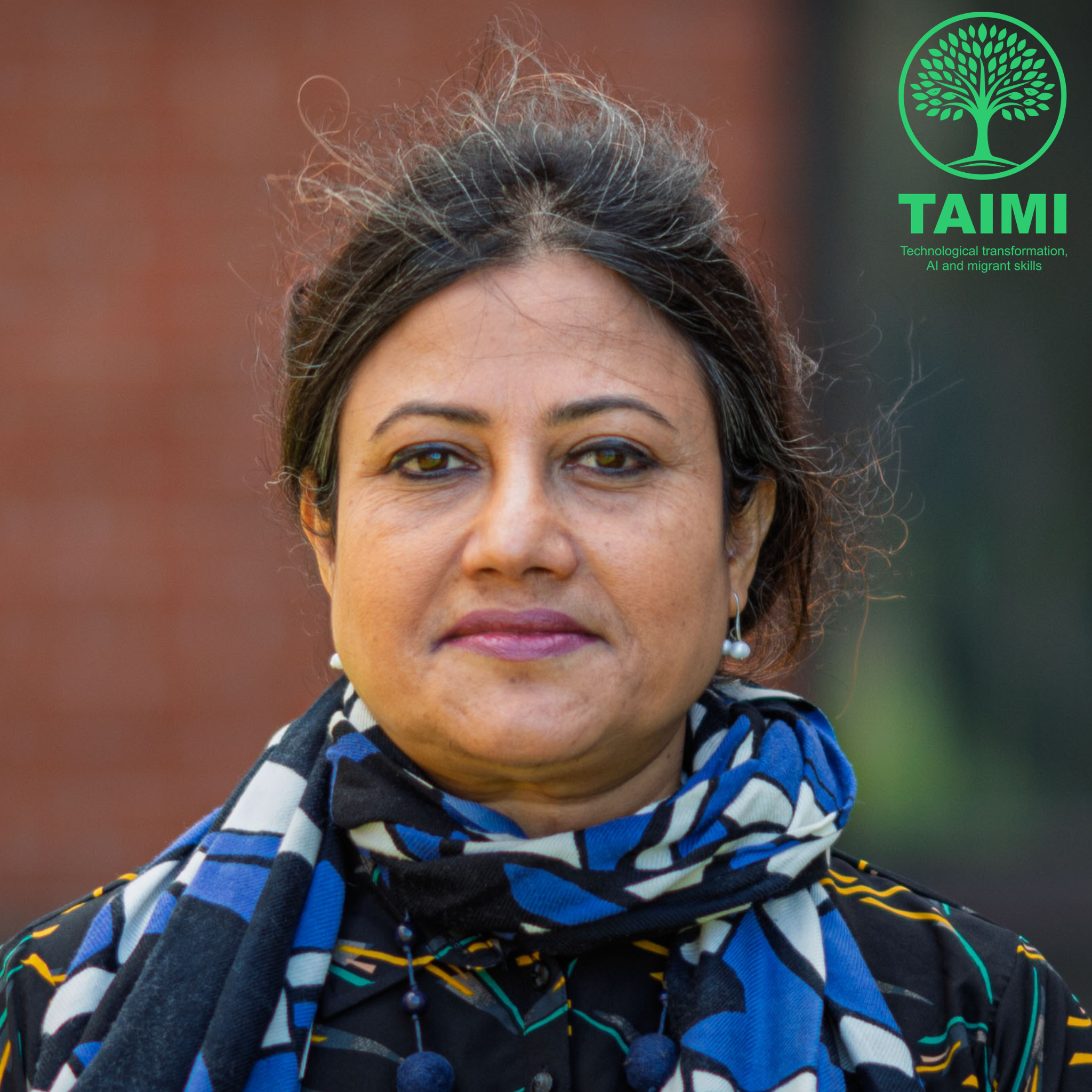
Skills That Go Unseen
Shahnaj Begum’s research began with a question she picked up in law school: why do people who have equal rights on paper not always have equal opportunities in real life?
Shahnaj studied law at the University of Dhaka in Bangladesh, where she completed an LLB (Honours) and an LLM. Law introduced her to human rights, equality and social justice, and it also left her with that question. She has been working on it ever since, first in care work and later as a researcher.
“Why do people who have equal rights on paper not always have equal opportunities in real life?”
Twenty years in Finland
Shahnaj has now lived in Finland for more than twenty years. Over that time she has watched how migration, work and social policy shape people’s everyday lives. She started to ask whether migrants can take part fully, whether their skills are recognised, and whether they feel they belong.
For six years she worked as a care planner (Geronomi) in Helsinki, and that period shaped her more than any other. One memory has stayed with her. An older person in a care home spent Christmas completely alone, with no visitors before the holiday and none after. Another resident had a visitor every day, because their children took turns coming.
“I saw how much a close family can mean. It was hard for me to accept how different these two lives were.”
She also noticed that most of the older people she met were women, and so were most of the caregivers. Many of those caregivers had an immigrant background. She began to wonder how to build an age-friendly environment for older people, and a work-friendly one for the people caring for them.
From the care home to a PhD
That question took Shahnaj to the University of Lapland, where she completed her PhD in 2019. Her thesis, “Ageing and Gender in the Nordic Arctic”, looked at how equality and social justice can help explain the challenges older people face in the region. She found that older people’s physical and mental wellbeing depends strongly on an age-friendly environment, and that when the Arctic changes, older people often feel less secure, especially older women.
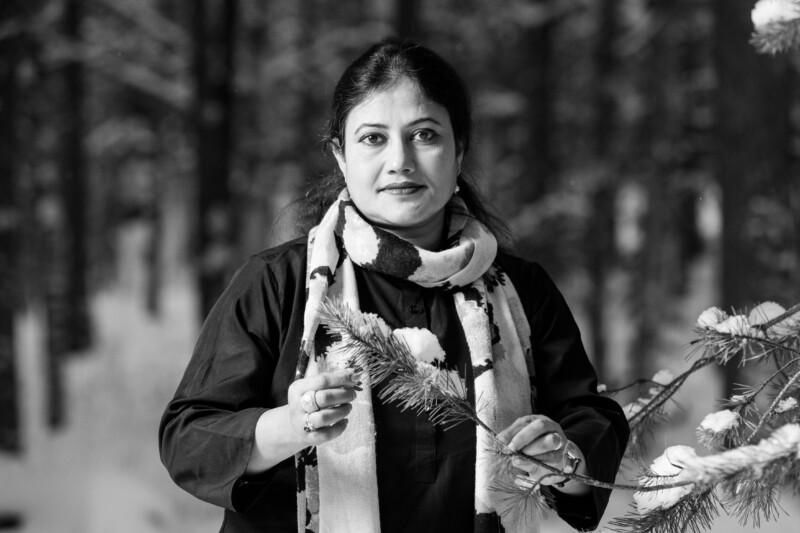
As a postdoctoral researcher she turned to older people with a non-European background living in Finland. Today she works as a University Researcher at the University of Helsinki, and her interests now include digital inclusion, digital skills, care and the changing nature of work. For her, technology is a question about real situations.
“For me, these are not abstract questions. They are about whether an older person can use an online service, and whether a caregiver’s knowledge is valued.”
What caregivers bring to work
In TAIMI, Shahnaj has interviewed immigrant and Finnish caregivers, as well as care managers. These interviews changed her thinking about skills more than anything else. She kept seeing a gap between what people bring to a workplace and what the workplace notices.
An immigrant caregiver may have many years of experience. They may know different ways of giving care, speak several languages and understand the needs of people from different cultures. These strengths are not always recognised as professional skills, and they are rarely used to develop the workplace.
The interviews also taught her to separate two things that are easy to mix up: language skills and professional skills. Finnish matters, especially for safety and communication, but someone who is still learning it can be an excellent caregiver, with good judgement, empathy and a lot of practical experience.
“We need to see language learning needs and professional ability as two different things.”
She now thinks about skills more widely than certificates. They also grow through experience, relationships and everyday problem-solving. When workplaces cannot see them, they lose valuable knowledge, and employees may feel their experience is invisible.
Barriers that connect
Shahnaj sees several barriers in the Finnish labour market, and they feed into each other. Many people arrive with degrees and years of experience and end up in jobs below their level, which can wear down their confidence. Recruitment sometimes asks for a higher level of Finnish than the job needs, even though multilingualism is also a resource. Organisations often have fixed ideas about what a “good” employee looks and sounds like, and those ideas can quietly disadvantage people from other backgrounds. And hiring migrant workers is only a first step: they also need mentoring, training and a real chance to move into more responsible roles.
Digital tools add another layer. AI in recruitment could help make skills more visible, but if the tools are built on biased data, they can repeat and even increase discrimination.
“We should ask what AI can do. We should also ask whose knowledge and experience are included in it.”
For Shahnaj this matters for two reasons. Finland is ageing and many sectors need workers, so leaving people’s expertise unused makes little sense. It is also a question of fairness and dignity.
“People should not have to prove their worth again and again because of their name, or the country where they studied.”
Why TAIMI
TAIMI fits closely with everything Shahnaj has worked on: migration, skills, care, technology and inclusion. Her research on older people, including older immigrants, showed her that a good environment and new technology do not automatically bring equal opportunities. She also likes that the project is multidisciplinary, because these questions need people’s experiences, workplaces, labour market structures, policies and technology to be looked at together.
Her own part is to study cultures of care and the experiences of immigrant caregivers. She wants to understand how skills and diversity are seen in care workplaces, and how organisations can go beyond saying that diversity is good and make sure different kinds of knowledge are truly valued. It is the same wish she had in her care planner years.
“Personally, I believe research should lead to real change.”
She has spent many years studying people whose voices are not always heard in policy or decision-making. Her hope is that international talent in Finland will be seen as more than an answer to labour shortages: people with knowledge, goals, professional identities and the right to a meaningful working life.
If TAIMI succeeds
Shahnaj describes an immigrant who arrives in Finland with many years of work experience. In an inclusive workplace, that experience is recognised and their languages and cultural understanding are valued. They get support to improve their Finnish and other professional skills, and real chances to train, move forward in their career and take part in decisions.
She also hopes Finnish-born and migrant colleagues will learn from each other, and that organisations will ask a different question.
“Diversity should not be a problem that migrant workers must solve alone. It should be a shared resource and a shared responsibility.”
Instead of asking only whether migrant workers can adapt to them, organisations would also ask how they can change their own practices. AI and digital tools could help by showing skills that normal recruitment misses and by supporting learning and communication, as long as they are fair, open and designed together with the people who use them.
Shahnaj thinks the effects would reach beyond individual careers. When people can use their skills, organisations get new ideas, better teamwork and a stronger workforce. In elderly care, a better work environment for caregivers also means better care for older people.
“I hope for a working life in Finland where diversity is truly valued, where technology supports people instead of leaving them out, and where every worker can build a meaningful and lasting future.”