Exploring Leadership, Space, and Symbolism in Organizations
Exploring Leadership, Space, and Symbolism in Organizations
Understanding organizations requires looking beyond formal structures and strategies to the often subtle ways leadership, coordination, and control are expressed in everyday environments. This theme was at the center of a recent seminar delivered by Professor Rebecca Piekkari at the Ludwig-Maximilians-Universität München (LMU) Center for Advanced Studies in Management.
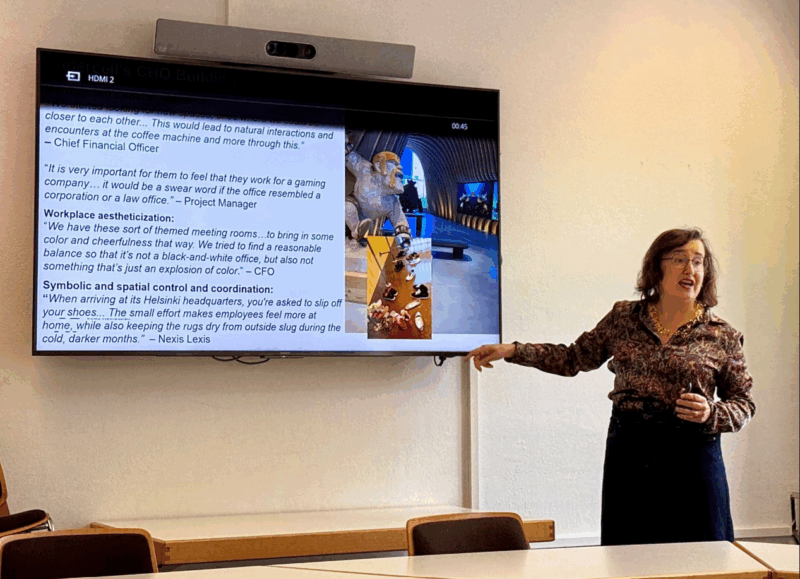
In her presentation, Rebecca explored how leaders use physical spaces as mechanisms of symbolic spatial coordination and control. Drawing on research conducted together with her coauthors, the study examined the headquarters of three Finnish companies through site visits, architectural analysis, and interviews with both architects and corporate leaders involved in designing the spaces.
The research highlights that corporate environments are far from neutral or purely functional. Instead, physical spaces are intentionally designed to communicate values, shape interpretations, and influence everyday behavior and interaction within organizations.
Examples from the study illustrated how aesthetics and symbolism can become embedded into organizational life. At Supercell’s headquarters in Helsinki, employees are encouraged to remove their shoes, creating a sense of familiarity and comfort associated with home. Fiskars’ headquarters, meanwhile, includes pet-friendly spaces, yoga facilities, and quiet rooms, reflecting efforts to connect employees’ professional and personal lives while strengthening attachment to the organization.
These examples demonstrate how modern corporate spaces increasingly serve not only operational purposes, but also symbolic and cultural ones. The growing “hotelification” of headquarters reflects broader organizational efforts to shape workplace experience, belonging, and behavior through carefully curated environments.
For TAIMI, this research resonates strongly with ongoing efforts to better understand the evolving nature of work, leadership, and organizational life. Rebecca Piekkari’s work continues to make important contributions to international discussions on qualitative research, organizational symbolism, and the subtle mechanisms through which organizations coordinate and influence human interaction.
The seminar also offered valuable reflections on the use of multimodal qualitative methods and the challenges of conducting innovative organizational research, sparking engaging discussions among researchers and doctoral students alike.
At TAIMI, we are proud to see Rebecca’s research contributing to critical international conversations that encourage us to view organizations — and the spaces they inhabit — from new and thought-provoking perspectives.