The Experience Behind the Research
When Chandra talks about migration and work, she does not start with statistics or policy.
She starts with a feeling she knows herself: arriving somewhere with experience, qualifications, and ambitions, and realizing that the things that once made your professional identity recognizable do not necessarily carry across borders.
When she moved to Finland as a skilled expatriate spouse, she went through the integration system herself. Her own experience was positive, but it also gave her a close-up view of something that stayed with her.
“Why do highly skilled migrants face such pervasive structural friction?“
There were highly educated and experienced professionals around her who were struggling to find work that reflected what they could actually do.
People who had built careers elsewhere were starting again. Some were pushed towards entry-level jobs. Others spent long periods underemployed. Their professional experience was there, but somehow it had become difficult for the labour market to see it.
For her. that experience eventually became more than an observation. It became a research question.
When experience stops being visible
At first, Chandra approached integration largely through the question of alignment: how do people’s qualifications and skills meet the needs of a new labour market?
“The visa category an individual holds often overshadows their qualifications, raising a critical
question: does a visa status define a person’s skill set?”
But the more people she spoke to, the more complicated that picture became.
“Migration radically disrupts the intricate architecture of professional resources, networks, and personal identity that individuals spend decades building in their home countries.”
Migration does not only move a person from one country to another. It can also interrupt the professional world they have spent years building.
Networks disappear or become harder to access. Previous achievements may no longer be familiar to employers. Professional identities that once felt secure can suddenly become much less certain.
And there can be a psychological cost to that.
“When a host country’s labour market fails to recognize prior achievements, it creates a profound self-worth crisis.”
In her interviews with skilled expatriate spouses and other international professionals, Chandra encountered people who had begun to internalize the lack of recognition they were experiencing. When your skills are repeatedly overlooked, it can become difficult to separate the system’s judgement from your own sense of what you are capable of.
“The crisis of confidence often lingers, causing individuals to evaluate their value even after re-entering the workplace.”
This was one of the things that changed her understanding of inclusion.
Finding someone a job is important. But meaningful inclusion has to go further. It also means creating the conditions for people to regain recognition, confidence, and a sense of belonging in their professional lives.
From something personal to something bigger
This is part of what led Chandra to TAIMI.
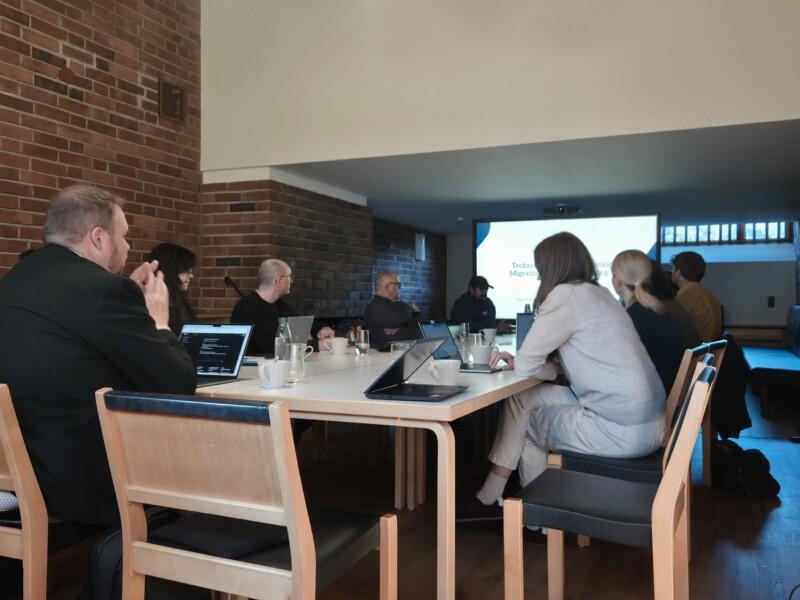
“TAIMI’s mission represents a crucial bridge between theory and practice.”
Her work had already brought her to questions around recruitment bias, technology, and the ways institutions can either create or remove barriers for international talent. But TAIMI offered a space to take those questions beyond research and think about what could actually change.
“Diversity must be approached as a trainable skillset.”
One idea is particularly important to her: diversity should not be treated as something organizations either have or do not have. It can be developed as a skill.
That changes the conversation.
Instead of asking international professionals to constantly adapt themselves to systems that were not designed with them in mind, we can also ask how those systems could become better at recognizing different forms of experience and expertise.
Technology is part of that conversation too.
AI and other technology-enabled recruitment tools have the potential to change how candidates are assessed and to reduce some forms of bias. But technology is not a shortcut around the problem. It has to be developed alongside changes in organizational practices and institutional thinking.
For Chandra, that combination is what makes TAIMI meaningful: bringing together research, technology and lived experience to work on a problem that is ultimately about people.
Seeing talent differently
The larger question behind all of this is not only how Finland can attract international professionals.It is how Finland can recognize the talent that is already here.
“Failing to recognize skilled spouses is both a human tragedy and a wasted opportunity for the Finnish economy.”
A person should not become less skilled because their qualification was earned somewhere else. A visa category should not become a shortcut for judging someone’s professional potential. And being unfamiliar to a recruiter should not mean being overlooked.
“International professionals would be recognized for their actual domain expertise from the moment they arrive.”
If those barriers can be reduced, the effects reach beyond individual careers.
International professionals can contribute their expertise earlier and more fully. Organizations gain access to a wider range of skills and perspectives. And Finland becomes better equipped not only to attract international talent but also to retain it.
For Chandra, this is why the questions at the heart of TAIMI matter personally.
They began with something she experienced herself. They grew through the stories of people she met through her research. And they have now become part of a much bigger conversation about the future of work in Finland.
Because building a more inclusive labour market is not only about helping people enter it.
It is about making sure that once they arrive, their experience still counts.