
Rebecca Receives Best Paper Award at the 19th GEM&L International Conference
Rebecca has received the Best Paper Award at the 19th GEM&L International Conference on Language and Management 2026, held at BI Norwegian Business School in Oslo, Norway, from 27–29 May 2026.
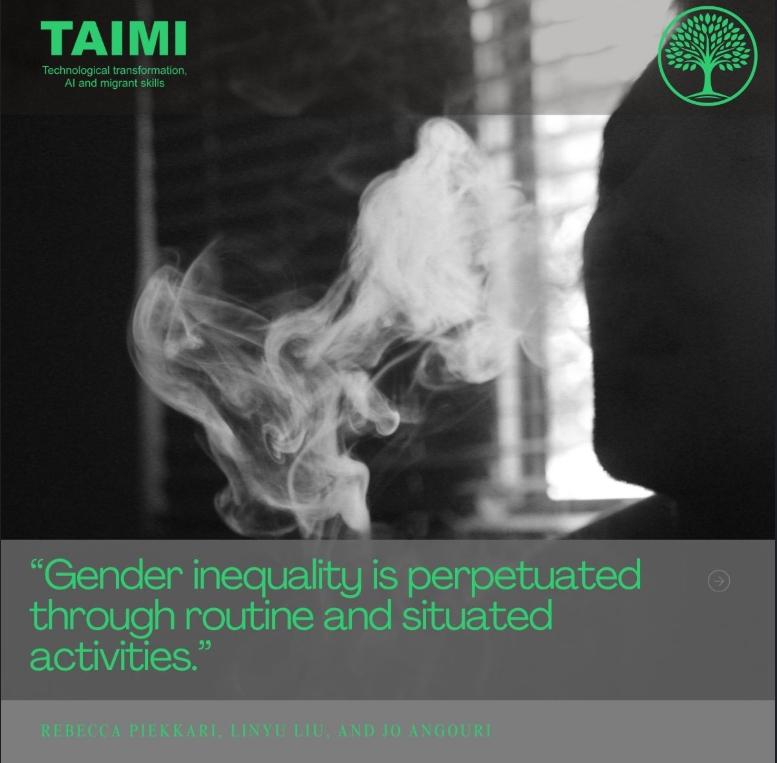
The award recognises her paper, “Where smoke lingers: Cigarette smoking as a gendered practice from a discursive-spatial lens,” co-authored with Linyu Liu and Jo Angouri.
Looking beyond formal equality
Despite the widespread adoption of formal equality policies, gender inequality continues to persist in workplaces. While considerable attention has been given to formal structures and organisational policies, less is known about how inequality can be reproduced through mundane interactions, informal norms, and the spaces in which workplace relationships develop.
The paper turns its attention to one such everyday practice: cigarette smoking.
Drawing on an ethnography-informed study of a Finnish multinational’s operations in China, and grounded in a critical feminist constructionist perspective, the authors examine how smoking becomes a gendered organisational practice.
At first glance, a smoking break may appear to be simply a moment away from work. Yet, when colleagues gather in a smoking room, these informal encounters can become important spaces for conversation, relationship-building, and the exchange of information.
The question, therefore, is not simply who smokes, but who gains access to the social and organisational networks that form around smoking.
When space becomes part of inequality
The study conceptualises the smoking room as more than a physical location. It is a material and social space that actively participates in the construction of gendered relations.
The formation of a predominantly male “smoking circle” can create an informal network from which women are excluded. Through repeated and seemingly ordinary interactions, this exclusion can contribute to the reproduction of broader workplace inequalities.
The authors examine the discursive and spatial construction of three interconnected elements: the act of smoking, the smoking room, and the smoking circle. Together, these elements can sustain an ideology of masculinity and shape who participates in informal workplace networks.
As the authors argue, the significance of such practices lies precisely in their ordinariness. Inequality does not always emerge through explicit discrimination. It can also be reproduced through routine, situated activities that appear neutral or inconsequential.
The paper ultimately proposes a dynamic model of how gender inequality is perpetuated through routine workplace practices, highlighting the importance of paying attention to the informal spaces and interactions that sit alongside formal organisational structures.
“The smoking room” is not simply a physical space; it can actively shape gendered relations.
This perspective invites a broader reflection on workplace inclusion. Creating formal equality is important, but understanding how inclusion and exclusion are produced also requires attention to the everyday practices through which people build relationships, exchange information, and participate in organisational life.
We congratulate Rebecca, Linyu Liu, and Jo Angouri on receiving the Best Paper Award and on this contribution to research at the intersection of language, management, space, gender, and organisational inequality.